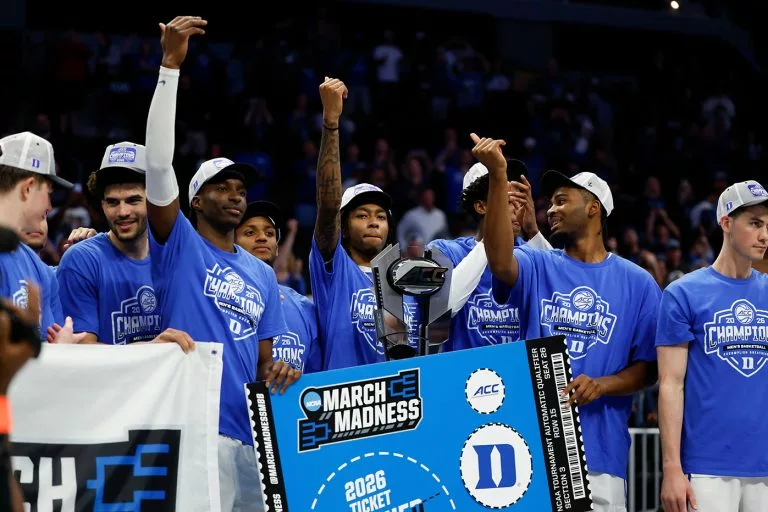
Duke players celebrate earning a spot in the NCAA tournament
What Is March Madness? NCAA Basketball Tournament Guide
March Madness, the yearly NCAA Division I men’s and women’s basketball tournament, is one of the biggest sporting events in American sports—not just college.
The contest’s single-elimination format between 68 teams over just three weeks makes it a high-stakes stage in a short timespan where just one team can be crowned the men’s and women’s NCAA Division I champions.
College sports in the USA has its own die-hard fan base, intimately tied to hometown and alma mater pride. Since starting in 1939, the tournament has shut down the world of college sports while dedicated and casual viewers alike tune in for dramatic upsets and historical Cinderella stories.
The tournament has also been the proving grounds where a lot of future
NBA
and
WNBA
stars cut their teeth: Steph Curry (Davidson 2008), Caitlin Clark (Iowa 2023/24), and Michael Jordan (1982-84) all cemented their legacies playing in March Madness.
But why is March Madness such a big deal? What’s all this talk about “the bracket”? And why is it called that anyway? We’ve got all those answers and more in our complete 2026 guide to
March Madness.
NCAA March Madness tournament logo at center court
What Type of Tournament Is March Madness?
March Madness is a single-elimination tournament where every game is win-or-go-home. Once the bracket begins, there are no second chances.
That’s what makes the tournament so compelling. Over just a few weeks, 68 teams are reduced to one national champion. Heavy favorites can fall early. Underdogs can catch fire. Momentum matters.
How Many Participants Are There in March Madness?
Each year, 68 teams qualify for the NCAA Division I basketball tournament—in both the men’s and women’s competitions (136 teams total).
The men’s and women’s contests are split into two separate 68-team tournaments:
Before the main bracket begins, four preliminary games—known as the First Four—reduce the field from 68 to the traditional 64-team bracket.
From there, the tournament unfolds across six rounds until a single men’s champion and women’s champion is crowned.
How Are Teams Selected for March Madness?
Teams reach March Madness in one of two ways: automatic bids or at-large selections.
Automatic Bids
Men’s and women’s Division I college basketball is made up of 32 conferences—groups of universities that regularly compete against each other during the season. The most well-known conferences include the Atlantic Coast Conference (ACC), Big Ten Conference, and Southeastern Conference (SEC).
Each conference receives one automatic bid to the NCAA tournament, usually awarded to the winner of that conference’s postseason tournament.
Because of that, conference tournaments often produce some of the most dramatic moments of the season. For smaller programs especially, winning the conference tournament is the clearest path to March Madness.
At-Large Bids
The remaining spots are filled by at-large selections, chosen by the NCAA selection committee.
The
committee evaluates teams
using a range of factors, including:
- Strength of schedule
- Quality wins
- Overall record
- Advanced metrics and rankings
Their goal is to identify the strongest teams that didn’t win their conference tournament.
Once the field is finalized, the committee seeds every team and builds the tournament bracket. The full field is then revealed on Selection Sunday, when fans and teams alike see how the bracket has been set for the tournament ahead.
How Is March Madness Structured?
March Madness
follows a six-round structure
once the main 64-team bracket begins.
Here’s how it unfolds:
- First Round (Round of 64)
- Second Round (Round of 32)
- Sweet 16
- Elite Eight
- Final Four
- National Championship
Teams are divided into four regions, each containing 16 seeded teams.
The winner of each region advances to the Final Four, where the final two teams meet in the national championship game.
Because each round eliminates half of the remaining teams, the tournament moves quickly. In just a few weeks, the entire bracket is decided.
When Does March Madness Happen?
March Madness typically runs from
mid-March through early April:
- Selection Sunday:
The full tournament bracket is revealed
- First Four:
Opening play-in games
- First & Second Rounds:
The tournament’s opening weekend
- Sweet 16 & Elite Eight:
The second week of games
- Final Four:
Early April
- National Championship:
The following Monday night
Key March Madness Dates for 2026
For the 2026 NCAA tournaments, the key dates are:
- Selection Sunday:
March 15, 2026
- First Four:
March 17–18, 2026
- First Round:
March 19–20, 2026
- Second Round:
March 21–22, 2026
- Sweet 16:
March 26–27, 2026
- Elite Eight:
March 28–29, 2026
- Final Four:
April 4, 2026
- National Championship:
April 6, 2026
Why Is It Called March Madness?
The name “March Madness” comes from the unpredictable energy the tournament creates every spring.
The month of March becomes a blur of buzzer-beaters, upsets, and bracket-busting results. For fans, it can feel a little like controlled chaos—hence the “madness.”
The phrase was first used in 1939 by Illinois high school official Henry V. Porter to describe the excitement surrounding the state’s high school basketball tournaments.
The term later gained national popularity during NCAA tournament broadcasts in the 1980s. Popular commentators like Brent Musburger began saying it to capture the spontaneity of college basketball’s postseason.
The term is still accurate 87 years later.
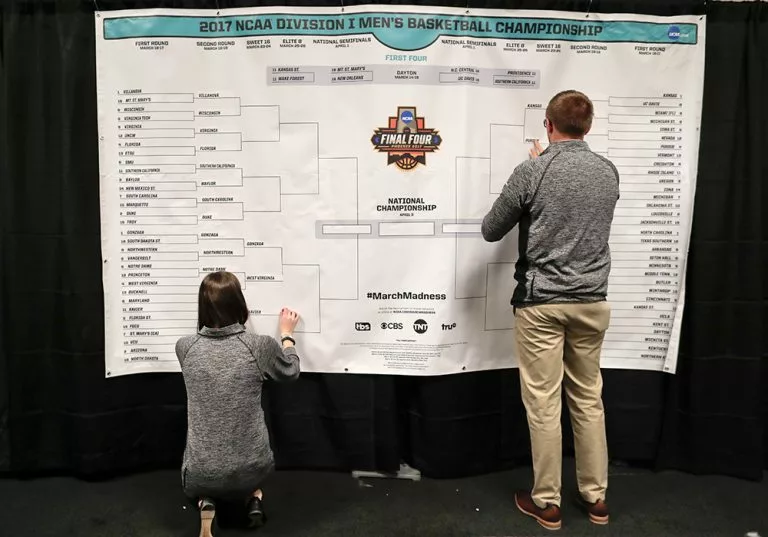
NCAA staff filling out the tournament bracket ahead of the Sweet 16
What Is the “March Madness Bracket”?
The March Madness bracket is essentially the tournament’s roadmap.
It lays out the teams in the field, their seed, and the path they’d need to take to reach the national championship. Each game feeds into the next round until only one team remains.
For many fans, the bracket is what March Madness is all about.
Before the tournament tips off,
people fill out their brackets—predicting the winner of every matchup from the opening round all the way through to the title game. Offices, friend groups, and online communities often run
bracket pools, with entries competing for sweepstakes prizes, betting payouts, or simply bragging rights.
It’s a tradition that turns the tournament into something interactive. Fans might spend days studying matchups, debating potential upsets, and trying to build the perfect bracket.
Of course,
a perfect bracket is almost impossible—which is why it has become the Holy Grail of March Madness for many college basketball fans. With dozens of games and upsets happening every year, even the most carefully researched picks rarely stay intact for long.
But that unpredictability is exactly the point. Filling out a bracket gives every fan a stake in the madness from the very first tip-off.
Why Is March Madness Such a Big Deal?
Several things combine to make March Madness one of the most compelling sporting events each year.
The Single-Elimination Stakes
Every game could be a team’s last. That urgency creates drama from the opening round to the championship.
Upsets and Cinderella Stories
Lower-seeded teams
regularly defeat top programs. When an underdog makes a deep run, it becomes one of the tournament’s defining stories.
National Attention
For a few weeks, college basketball takes center stage. Multiple games run throughout the day, drawing fans who might not follow the sport the rest of the year.
Future Stars
March Madness has long been a stage where future NBA and WNBA talent emerges. Breakout performances can turn college players into national names overnight.
Put together, those elements create a tournament where anything feels possible—and often is.
When Did March Madness First Start?
The first NCAA men’s basketball tournament took place in 1939.
That inaugural event featured just eight teams, with the Oregon Ducks men's basketball defeating the Ohio State Buckeyes men's basketball in the championship game.
Over the decades, the tournament expanded steadily:
- 8 teams (1939)
- 16 teams (1951)
- 32 teams (1975)
- 64 teams (1985)
- 68 teams (2011–present)
The NCAA women’s tournament began later, launching in 1982. Since then, it has grown into one of the most prominent events in women’s sports.
Today, both tournaments draw massive audiences and produce some of the most memorable moments in college basketball.
When Did the March Madness Women’s Tournament Start?
The NCAA Division I women’s basketball tournament began in 1982, marking the first time the NCAA officially organized a national championship for women’s college basketball.
Before that, the women’s national tournament was run by the Association for Intercollegiate Athletics for Women (AIAW), which governed women’s college sports throughout the 1970s and early 1980s. In 1982, both the AIAW and NCAA held tournaments, but the NCAA event soon became the primary national championship as the AIAW dissolved shortly afterward.
Like the men’s tournament, the women’s event has grown significantly over time. It now features 68 teams and follows the same single-elimination format, culminating in the Women’s Final Four and national championship game each spring.
In recent years, the women’s tournament has drawn record audiences and national attention. Star players like Caitlin Clark and Angel Reese (both now WNBA players) have helped elevate the profile of the event, highlighting the depth of talent across women’s college basketball.
Today, the women’s tournament stands neck and neck with men’s March Madness on the college basketball calendar.
Who Has Won the Most March Madness Tournaments?
In the men’s tournament, the most successful program historically is the UCLA Bruins men's basketball.
Led for much of that era by legendary coach John Wooden, UCLA won 11 national championships, including an extraordinary seven straight titles from 1967 to 1973.
Other historically successful programs include:
- Kentucky Wildcats men's basketball
- North Carolina Tar Heels men's basketball
- Duke Blue Devils men's basketball
In the women’s tournament, the UConn Huskies women's basketball has dominated the modern era, winning 11 national championships under coach Geno Auriemma.
While a handful of programs have built lasting dynasties, March Madness remains unpredictable. Every year begins the same way—with a full bracket and 68 teams believing they can make the final run.
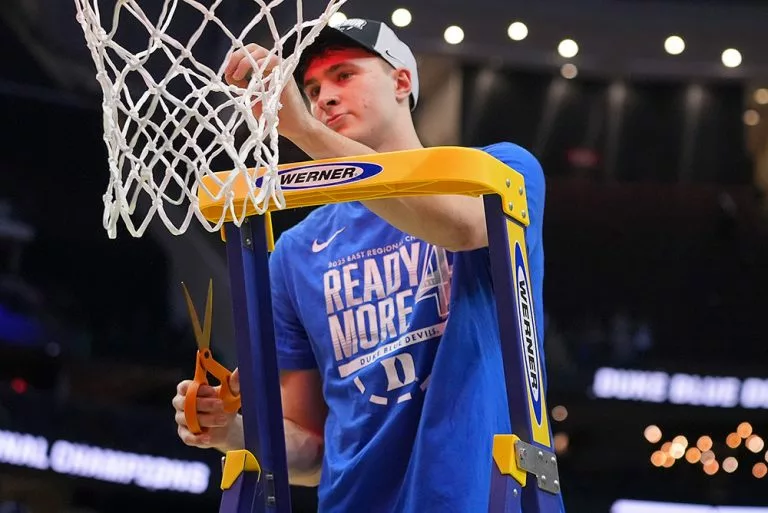
Player cutting down the net after NCAA championship win
Why Do Teams Cut Down the Nets?
One of the most enduring traditions of March Madness happens right after the championship game: the winning team cuts down the nets.
After the final buzzer, players climb ladders to snip pieces of the basketball net from the hoop as a keepsake, with the final cut usually reserved for the head coach.
The ritual dates back decades and has become a symbolic way of celebrating the journey through the tournament.
Today, it’s one of the most recognizable images of March Madness—players holding strands of net above their heads while confetti falls around them.
March Madness in a Nutshell
For longtime college basketball fans, March Madness is a tradition. For newcomers, it’s one of the easiest tournaments in sports to get swept up in.
The format is simple, the stakes are immediate, and every game carries the chance for something unforgettable.
That combination is what keeps the tournament compelling year after year—and why, every March, the bracket resets and the madness begins again.
If you or someone you know is struggling to gamble responsibly, these free, confidential resources can help:

To make sure you get accurate and helpful information, this guide has been edited by
Nick Slade
as part of our fact-checking process.


 Available with Dimers Pro