Sep 26, 2026
Best bets today for all sports: Saturday's picks include Colorado vs. LA Galaxy MLS play [9/26/2026]
Read Article 
We explore the key differences between new Prediction Markets trading platforms and the traditional Sports Betting apps.
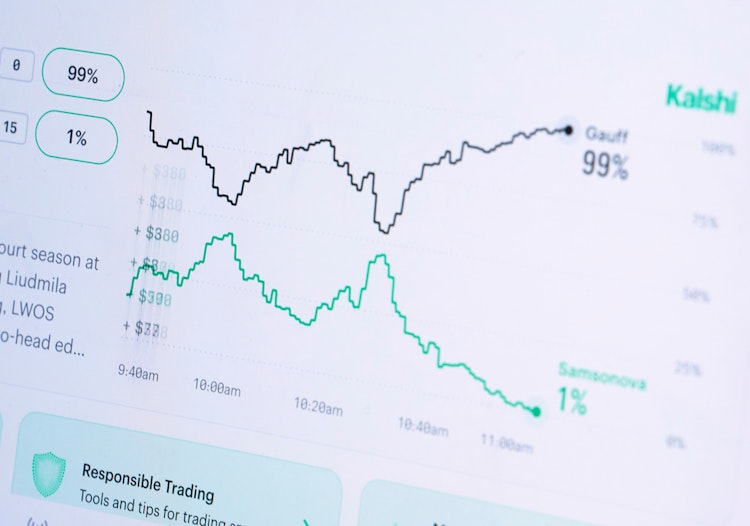
The landscape of wagering is undergoing a seismic shift. Whether you are a seasoned sharp or a casual fan, you’ve likely noticed a new player on the field: Prediction Markets (PMs). While Real Money Gambling and Prediction Markets offer a common goal—turning a correct forecast into a profit—the "how" and "why" behind them couldn't be more different.
At Dimers, predictions are the heartbeat of everything we do. Whether you're placing an MLB parlay at a sportsbook or trading a contract on an exchange like Kalshi, our mission remains the same: providing machine-learning probabilities to help you find the edge.
The first major difference lies in how the activity is classified. At a traditional sportsbook, you are engaging in a centralized model where you are effectively playing against "the house." The bookmaker sets the odds, and you decide if you want to take them. It is legally categorized as gambling or gaming, and your success is the house's loss.
Prediction markets, conversely, operate on a peer-to-peer model. You aren't betting against a corporation; you are trading against other individuals. You buy and sell "shares" or "contracts" in a specific outcome, much like you would buy stock in a company.
Because these are structured as event contracts, they are often regulated as financial derivatives—making the experience feel much closer to the floor of the New York Stock Exchange than the floor of a Las Vegas casino.
Complexity has long been a barrier for new participants in the sports world. Sports bettors often require calculators to understand American odds; seeing a team at -160 or a longshot at +350 doesn't immediately tell the average person what the likelihood of winning actually is. Then you have to account for "the juice"—the house's built-in profit margin—to find the true probability.
Prediction markets have gained massive traction by stripping away this jargon in favor of a simple share price between $0.01 and $0.99. If a contract for a team to win is trading at $0.60, the market is telling you there is a 60% implied probability of that event happening. It is intuitive: you buy for 60 cents, and if you're right, the contract settles at $1.00, netting you a 40-cent profit. This transparency allows for far more flexibility, as traders can buy low and sell high throughout a game, exiting their positions whenever they like rather than being "locked in" until the final whistle.
If you live in New York or New Jersey, you have the luxury of choice—you can open a sportsbook app or a prediction market exchange. However, for the millions of sports fans in California, Texas, or Georgia, online sports betting remains illegal at the state level.
This is where the distinction becomes a game-changer. Because platforms like Kalshi and Polymarket operate under federal frameworks (like the CFTC) rather than state-by-state gaming commissions, they are often available in states where online sportsbooks are banned.
For residents in these non-regulated states, prediction markets aren't just an alternative; this type of trading actually represents the only legal, regulated way to put their sports knowledge to the test.
Why is one called "gambling" and the other "trading"? Well, it comes down to oversight.
Sportsbooks are regulated by State Gaming Boards, meaning each individual state must vote to legalize it. This is why the betting map of the U.S. currently looks like a patchwork quilt.
Prediction markets operate under the watch of the Commodity Futures Trading Commission (CFTC). By treating the outcome of a game or a political election as a "commodity," these platforms can offer "event contracts." This classification allows them to operate under federal financial laws, bypassing the state-level hurdles that have stalled online sports betting launches across much of the country.
The modern bettor is smarter than ever. The era of betting on your favorite team because of a hunch is being replaced by the sophisticated, data-driven approach offered by Dimers Pro.
Prediction markets cater specifically to this less-recreational crowd. Because the price of a contract is a direct reflection of the crowd's aggregate knowledge, it allows users to apply mathematical models more cleanly. When using a sportsbook, you are first trying to beat the house's margin, let alone find an edge. In a prediction market, you are searching for pure market inefficiencies—situations where the crowd has priced a contract at 40 cents, but the data suggests it should be 55 cents (aka a 55% chance).
At Dimers Pro, we sit at the intersection of these two worlds. While the user interface might look different—one with betting slips and one with price charts—the analytical engine remains the same.
Our AI and machine learning models simulate games thousands of times to determine the true probability of an event.
For the bettor: We identify value, or +EV, bets where the sportsbook’s odds are more favorable than our projected probability says they should be.
For the trader: We showcase price "gaps" where a contract on a prediction market is undervalued based on our ML models.
Whether it’s a game-level best bet or a specific player prop, we provide the math so you can make an informed decision—no matter the type of platform. In 2026, the distinction between a "bettor" and a "trader" is blurring—and for those armed with the right data, the opportunity has never been greater.


Nick Slade, with nearly two decades of experience, is the Chief Content Officer at Cipher Sports Technology Group, overseeing content for Dimers. He specializes in soccer, NBA, and NHL betting, leveraging predictive analytics and machine learning to provide accurate betting insights.