Apr 14, 2026
Dimers Partners with OG: Trade on Probabilities, Not Just Predictions
Read Article 
The annual Army-Navy game sets the stage for one of the biggest rends on college football, but does the Dimers data back it up this year?
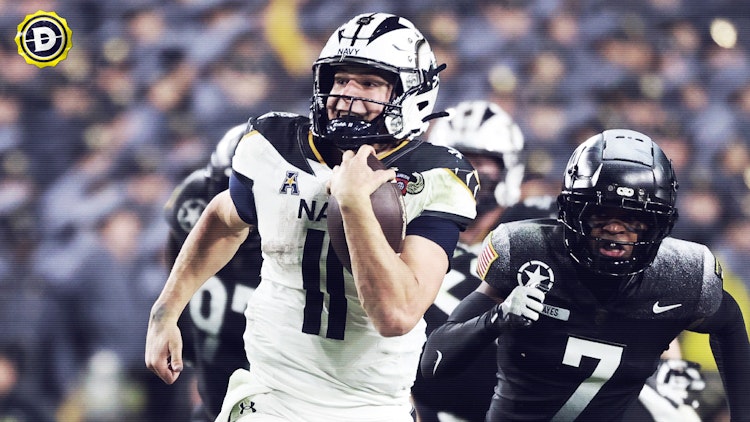
Few rivalries in sports are as tradition-rich as Army vs. Navy, and few betting trends are as famous as the one tied to it this annual December matchup.
For the past two decades, Unders have dominated college football betting in games between two service academies, going 46-12-1 back to 2005.
The annual Army vs. Navy matchup has been the microcosm of that trend, with two teams built on methodical triple-option offenses, limited possessions, and squads that know each other’s schemes better than anyone else in the country.
From 2006 through 2021, every Army-Navy game went under the total. What once saw a line set in the low 50s and up hasn't cracked 50 points since 2015, trending downward almost every year.
Sportsbooks eventually reacted to the seemingly guaranteed trend, and totals dropped into the low 30s — a sign the market had fully absorbed the trend.
At the same time, the offenses have evolved to feature more dynamic passing, perfectly countering the increasingly low total.
Last season's pre-game total of 39.5 was the highest since 2019 and along with the lower total, the opposite result is happening: the last three Army-Navy games have gone Over (39.5), Push (28) and Over (32).
That’s why using Dimers’ college football predictions is so important for 2025
Instead of relying on outdated assumptions or following public sentiment, the model evaluates the matchup through 10,000 simulations, showing whether this year’s Army–Navy game fits the classic profile or will continue the more recent one.
This year’s sportsbook total of 38.5 sits far higher than the extremely low numbers we saw when the trend peaked.
And Dimers’ model suggests that the scoring profile should land a little closer to a more “modern” service academy game than a vintage 14–10 rock fight.
After 10,000 simulations, the Dimers model is split on the total with a 50% probability in either direction; however, our final projected score is a 22–17 Navy win, a combined score of 39 points — just slightly above the posted total.
That's not significant enough to slam the door on the historical Under trend, but it does signal that this year’s matchup profiles with more scoring upside.
The Total has climbed from 37 at opening which isn't too much, but when combined with the line movement of Navy -4.5 to the current line of Navy -6.5, the sportsbooks seem to be expecting more scoring at least in favor of the Midshipmen.
The model accounts for Navy’s strong offensive success rate, Army’s ball-control approach, and the unique familiarity both defenses have with the option-based schemes.
Even with all that baked in, simulations still point to a game that leans toward moderate scoring rather than the extreme Under results bettors are used to citing.
The Under will always be part of the Army–Navy identity, and history shows why the public gravitates toward it
But 2025 isn’t the same landscape that produced a wave of easy cashes in previous years as recent results have proven.
Dimers’ simulation data gives this matchup a scoring projection above the betting total, suggesting that the market may be overvaluing the trend once again.


Dave Garofolo uses sophisticated AI-driven analytics to make predictions and evaluate player performances in the NBA, MLB, NFL, NHL, NCAAM, and PGA TOUR tournaments, crafting insightful game and prop previews.