Jul 23, 2026
World Cup betting: Dimers predictions return positive ROI across futures and pre-match markets
Read Article 
Dimers' World Cup predictions data is primed and ready to fire at this summer's tournament across the USA, Mexico, and Canada.

The countdown to the FIFA World Cup 2026 is officially on. From Thursday, June 11, the United States, Mexico, and Canada will host the biggest sporting event in history, and the question on everyone's lips is who will win the World Cup?
With more teams, more matches, and more eyes on North American soil than ever before, the 2026 World Cup isn't just a tournament—it’s a global phenomenon—and the latest World Cup data is in.
For fans looking to navigate this massive World Cup betting landscape, the sheer volume of data is overwhelming. How do you separate the signal from the noise when powerhouse nations meet dark horses from confederations they didn't face during qualifying, or potentially, have never faced before?
At Dimers, we don’t guess. We calculate. Dimers is a sports data science powerhouse with 10+ years—and three World Cups—of experience refining the "math over luck" equation to provide the most sophisticated World Cup predictions available to the public.
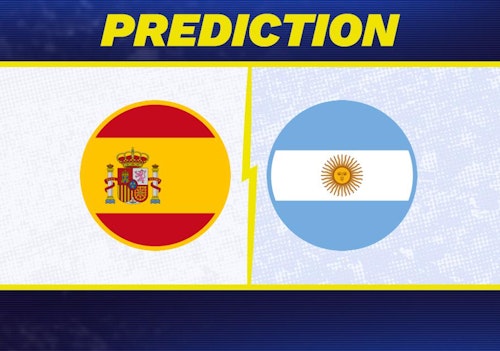
Spain will win the World Cup in 2026.
At least that's what the the world's best soccer predictions model says.
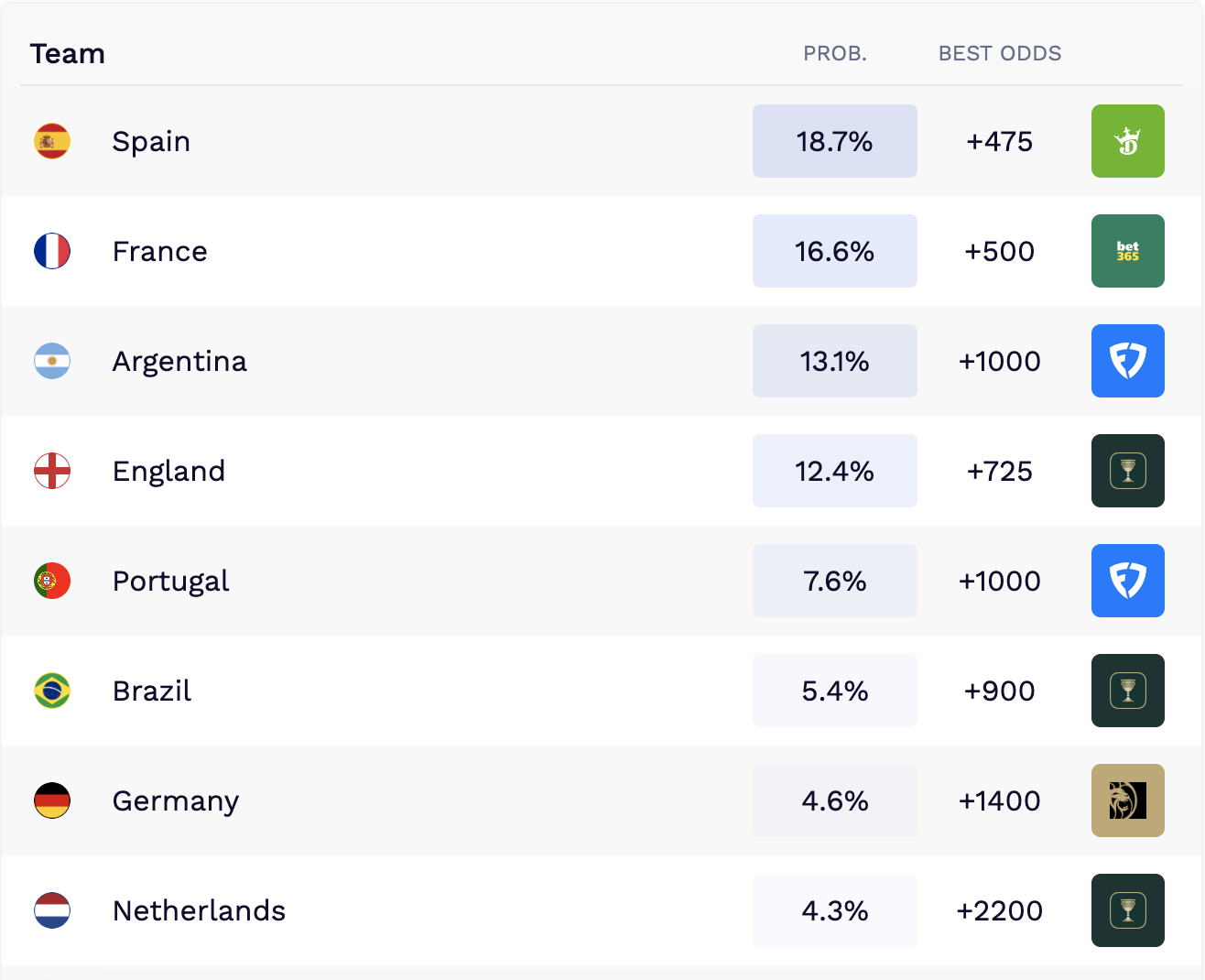
As the tournament approaches, and with squads announced, the latest World Cup Futures updates have found Spain to be a clear favorite at the top of the board, with Spain now given an 18.7% probability of lifting the trophy.
While Spain’s World Cup odds of +475 reflect their status as the World Cup favorites, our simulations have also identified that they offer significant betting value.
With an 18.7% chance of winning the tournament, fair World Cup odds for Spain would be +435, so anything above that is +EV.
The main challengers to Spain winning the World Cup are:
Spain, France, Argentina, and England are the only nations at this year's tournament with double-digit win probabilities, creating a clear 'Big Four' tier that separates the elite contenders from the rest of the pack.
For those hunting for FIFA World Cup best bets with higher payouts, the Netherlands emerges as a fascinating statistical outlier. Despite having just a 4.3% win probability, the Oranje are currently priced at fair +2200 odds, offering nearly double the return of other teams surrounding them—such as Brazil and Germany—in Dimers' World Cup rankings.
ANALYSIS: Can the USA win the 2026 World Cup?
While other platforms are only now spinning up their soccer World Cup models, the team at Dimers has been in the lab for over a decade - allowing us to create the World Cup winner predictions outlined above.
Our history covering global leagues like the EPL, La Liga, MLS, and Liga MX on Dimers has given us a foundational understanding of the "data environment"—knowing exactly which metrics drive winning outcomes and which are merely distractions.
However, the World Cup is a different beast entirely. You cannot simply apply a club-level model to international play and expect accurate results. For example, if you don't account for the unique complexities of cross-confederation play, your model might tell you New Zealand (0.00% and +200000) is the best team in the world.
We’ve spent a decade perfecting how we adjust for opponent strength and bridge the data gaps that others simply ignore.
Reliability is built through repetition. The 2026 World Cup marks our third consecutive tournament under the microscope. Having successfully modeled and covered both the 2018 and 2022 World Cups, alongside the Euros and Copa América, Dimers brings a level of "tournament-specific" expertise that is unmatched in the industry.
We understand the nuances of the group stage vs. the knockout rounds, the impact of travel across continent-sized host nations, and the motivational factors that human researchers often miss. Our models look for the World Cup best bets by processing millions of data points—identifying edges that the human eye, no matter how thorough, simply cannot see.
Whether you are looking to build your bankroll or simply want the most accurate insights for your office bracket, our tech offers a "math-first" lens:
The 2026 World Cup will be a tournament defined by its scale and its unpredictability. In an era where every fan has access to AI and basic stats, the real advantage belongs to those who can see the patterns beneath the surface.


Nick Slade, with nearly two decades of experience, is the Chief Content Officer at Cipher Sports Technology Group, overseeing content for Dimers. He specializes in soccer, NBA, and NHL betting, leveraging predictive analytics and machine learning to provide accurate betting insights.