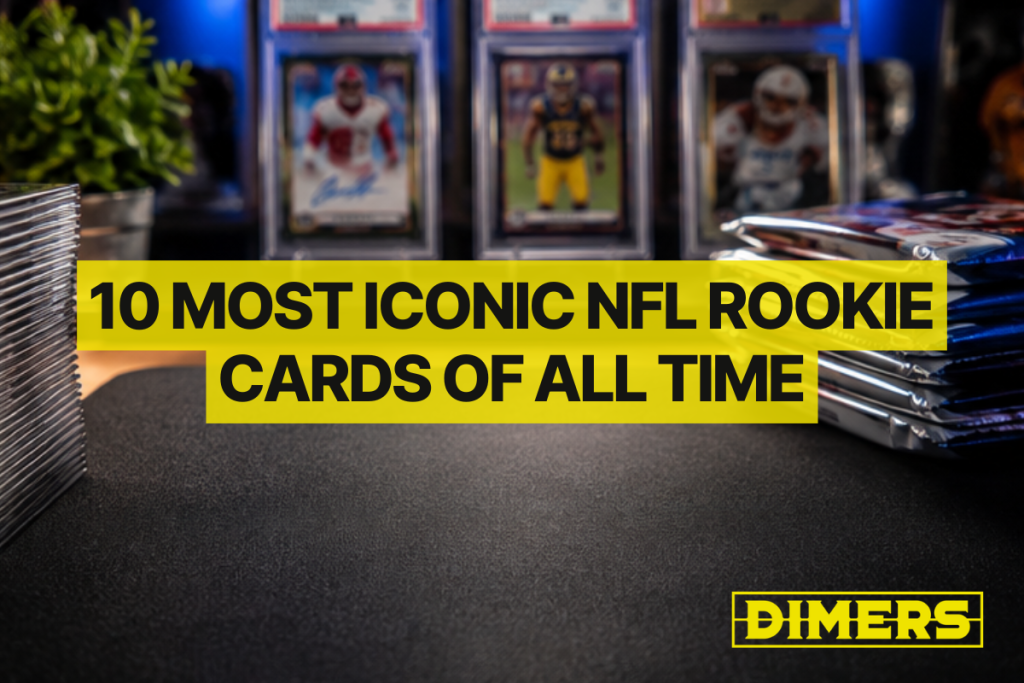
A 1935 Bronko Nagurski card and a 2017 Patrick Mahomes rookie have almost nothing in common. One is a nearly century-old piece of football history. The other comes with an autograph, a patch, and enough rare variations to confuse anyone new to collecting. Both have sold for extraordinary amounts.
That's what makes the most iconic NFL rookie cards so interesting. There's no single reason collectors chase them. Joe Montana and Jerry Rice have recognizable Topps rookies, while Tom Brady and Mahomes helped turn premium autographs into multimillion-dollar collectibles.
Some cards are rare because so few were made. Others are difficult to find without damaged corners, poor centering, or years of wear. These 10 cards show how much football collecting has changed, and why certain rookies still command attention decades after their release.
2000 Playoff Contenders Tom Brady Rookie Ticket Autograph #144
Nobody expected the 199th pick in the 2000 NFL Draft to become a seven-time Super Bowl champion. That unlikely rise is a big part of what makes Brady's Playoff Contenders autograph so special.
Unlike a standard rookie card, this one features Brady's signature. The Championship Ticket parallel, numbered to just 100 copies, is especially valuable.
The $3,107,032 sale in June 2021 involved a BGS 9 Championship Ticket. That's an important detail because Brady has several rookie-year cards, and they're certainly not all worth seven figures.
His standard Contenders autograph is valuable in its own right, but the Championship Ticket sits in another price category. For collectors comparing Brady rookies, the exact version matters just as much as the grade. A familiar card design doesn't necessarily mean the same print run or price.
1935 National Chicle Bronko Nagurski #34
Before million-dollar rookie autographs, there was Bronko Nagurski.
His 1935 National Chicle card is a cornerstone of early football collecting. Nagurski played fullback and tackle for the Chicago Bears, winning three NFL championships and building a reputation as one of the game's toughest players.
The card itself is nearly a century old. Surviving copies often have worn corners, faded surfaces, or centering problems.
Heritage Auctions sold a PSA 7 example for $402,600 in August 2026. Four years earlier, another PSA 7 brought $97,200. Same player, same card, same grade, and a price difference of more than $300,000.
Those results say plenty about the market for rare prewar football cards. Nagurski collectors aren't sorting through dozens of numbered parallels. They're competing for surviving copies of a card issued in 1935, and even a PSA 7 is a serious find.
1965 Topps Joe Namath #122
Few football cards look quite like Joe Namath's 1965 Topps rookie.
At roughly 4.7 inches tall, Namath's rookie was awkward to store alongside standard cards. That's a problem when a card needs to survive more than 60 years without damaged corners or edges.
The 1965 Topps #122 was also short-printed. Add the bright yellow background and Namath's place in football history, and there's plenty for collectors to care about beyond its price.
His guarantee before Super Bowl III is still famous. The Jets backed it up with a 16-7 win over the Baltimore Colts, giving Namath a place in NFL history that few quarterbacks can match.
His rookie combines football history with genuine condition rarity. PSA lists a guide value of $264,000 for a PSA 9, although guide values aren't confirmed sale prices.
1958 Topps Jim Brown #62
Jim Brown played just nine NFL seasons. Somehow, he led the league in rushing eight times.
His 12,312 career rushing yards and 106 rushing touchdowns explain why his 1958 Topps rookie remains a major football collectible.
It's also surprisingly difficult to find in excellent condition. The red borders make condition especially important. Chipped edges stand out immediately, and poor centering can hurt the grade even when the corners look good.
PSA has recorded only six PSA 9 copies and no PSA 10s, while a PSA 9 has sold for $336,000. That's a very different purchase from an ordinary lower-grade Brown rookie. The player is the same, but collectors chasing near-perfect copies have remarkably few options.
1957 Topps Johnny Unitas #138
Johnny Unitas helped turn the quarterback position into what fans recognize today.
The Baltimore Colts legend threw for 40,239 yards and 290 touchdowns, winning three NFL championships. His performance in the 1958 NFL Championship Game also helped bring professional football to a national television audience.
His 1957 Topps rookie doesn't have the visual personality of Namath's Tall Boy. It's a more traditional card, which makes its reputation especially interesting. The 1957 Topps set also includes Bart Starr's rookie, giving collectors two Hall of Fame quarterbacks to chase from the same release.
PSA lists nine examples graded PSA 9 and no PSA 10s. A PSA 8 sold for $8,600 in June 2026, while a PSA 7 fetched $2,375 that same month. That difference shows why collectors should pay attention to condition rather than simply chasing a famous name.
1976 Topps Walter Payton #148
Walter Payton's rookie card is a reminder that a great collectible doesn't need to be impossibly rare.
The 1976 Topps #148 features a young Payton in his Chicago Bears uniform. It's a straightforward design, but few running backs have a stronger legacy. Payton rushed for 16,726 yards and 110 touchdowns during his career. He also helped Chicago win Super Bowl XX.
Plenty of his rookie cards survive. Finding a perfect example is the challenge.
PSA has graded 56 copies PSA 10, compared with more than 3,200 PSA 8 examples. A PSA 9 sold for $10,111 in August 2026, showing how quickly prices can climb once condition enters the conversation.
For someone who simply wants Payton's rookie in a collection, a well-centered mid-grade copy makes more sense than paying a steep premium for a near-perfect one. The 1976 Topps design isn't especially complicated, so centering, clean borders, and overall eye appeal do much of the work.
1981 Topps Joe Montana #216
Four Super Bowl wins. Three Super Bowl MVP awards. Zero interceptions across those four championship games. That’s Joe Montana’s track record, and it gives his 1981 Topps rookie lasting appeal.
The card features Montana in his San Francisco 49ers uniform, with a simple design that has become a familiar sight in football collections.
A PSA 8 sold for $450, while a PSA 10 has reached $40,099.99. That's a steep premium for the final two grading points. It doesn't mean every PSA 10 will fetch the same amount, but it shows how much collectors value top-condition copies.
Montana entered the NFL in 1979, two years before this card appeared. It's still his recognized mainstream rookie card, an important detail when identifying vintage football releases.
1986 Topps Jerry Rice #161
The green borders on Jerry Rice's 1986 Topps rookie are beautiful. They're also a nightmare for collectors chasing perfect cards, making this particular card famous both for its distinctive design and unforgiving condition issues. Even minor edge wear can stand out against the dark green background.
Rice finished with 1,549 receptions, 22,895 receiving yards, and 197 receiving touchdowns. All three remain NFL career records.
Yet his 1986 Topps rookie isn't automatically an expensive card. A PSA 8 sold for $357 in August 2026, while a PSA 10 has a documented sale of $75,000.
That gap makes the green borders worth a closer look. Small chips or edge wear that barely register on another card can be obvious here. A collector paying top dollar for a PSA 10 is buying an exceptionally well-preserved item, not a different version of Rice's rookie.
1957 Topps Bart Starr #119
Bart Starr rarely gets the same modern hobby attention as Brady or Montana. His championship record deserves more respect.
Starr led Green Bay to five NFL titles, including victories in Super Bowls I and II. He was named MVP of both Super Bowls and became a central figure in Vince Lombardi's Packers dynasty.
His 1957 Topps rookie shares a set with Johnny Unitas, making it a particularly important release for vintage quarterback collectors.
Only three copies have earned a PSA 9 from PSA, and none have reached PSA 10. For a card issued in 1957, the supply of top-grade examples is remarkably small.
PSA's recorded PSA 9 sale price is $288,000. There aren't endless parallels or autograph variations to choose from here. The original card is the prize.
2017 Panini National Treasures Patrick Mahomes Rookie Patch Autograph #161
Mahomes represents the modern end of football card collecting, where autographs, jersey patches, and limited print runs drive enormous prices.
His 2017 National Treasures Rookie Patch Autograph features an on-card signature and memorabilia patch. The standard version is numbered to 99 copies.
The $4.3 million private sale in July 2021 involved the one-of-one Platinum NFL Shield parallel, graded BGS 8.5 with a 10 autograph grade. Only one copy of that exact version exists.
That's why the headline price needs context. The standard National Treasures Rookie Patch Autograph is numbered to 99, and other Mahomes rookies have entirely different designs, print runs, and values.
Three Super Bowl wins and three Super Bowl MVP awards have already made Mahomes a major figure in NFL history. His card market, though, is more complicated than the vintage Topps era. Knowing which parallel is being sold is essential before comparing prices.
What Makes an NFL Rookie Card Valuable?
A big name helps, but it doesn't explain why two copies of the same rookie card can sell for wildly different amounts.
Condition
is often the deciding factor. A PSA 10 Jerry Rice rookie has sold for $75,000, while a PSA 8 changed hands for just $357 in August 2026. Same card. Very different price.
Scarcity
matters, too. A 1935 Bronko Nagurski survives in limited numbers because of its age. Mahomes' National Treasures cards are scarce by design, with numbered parallels and one-of-one versions created specifically for collectors.
Then there's the
player. Championships, records, and Hall of Fame careers help keep demand alive, although none of those achievements guarantee a card will rise in value.
For collectors looking at
NFL card rips, it's worth checking which cards are actually available in a product. Operators normally specify the maximum value you can get out of a pack, as well as a full list of potential pulls.
If you want to start ripping packs online, take a look at our overview of the top
card rip sites
– we compare the leading platforms and explain everything you need to know before diving in.
Advertiser disclosure


 Available with Dimers Pro