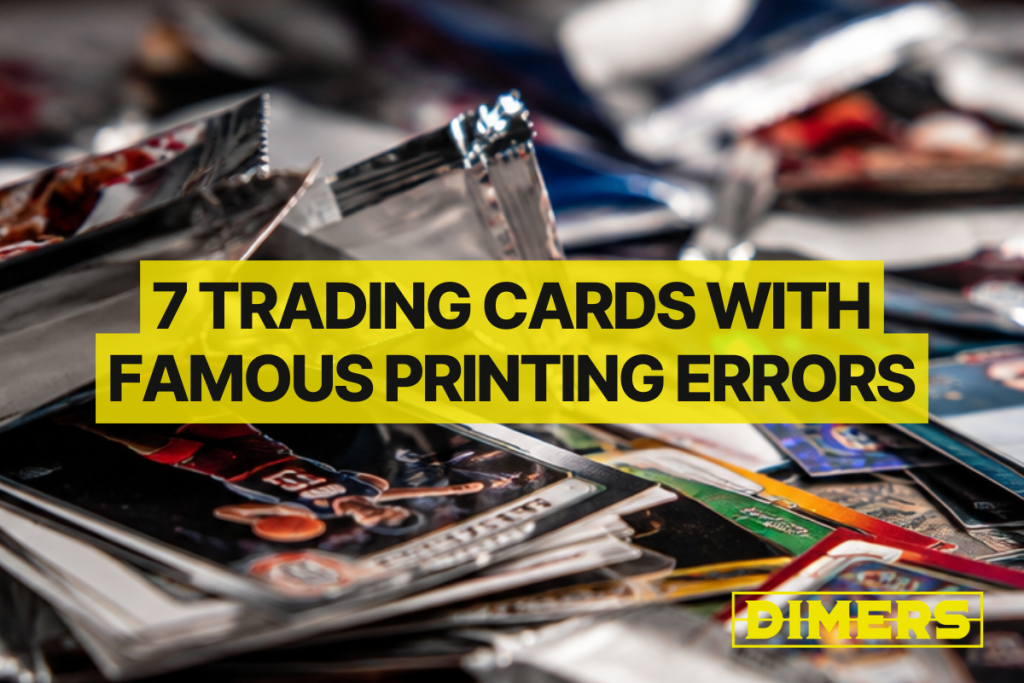
Most trading cards are printed in large runs, with manufacturers aiming for every copy to look identical. However, mistakes can slip through, such as a famous sports star’s name getting misspelled, an image appearing backwards, ink going missing, or the wrong image ending up on a card that was meant to depict somebody else.
Some errors are caught and corrected before the cards are distributed to the public, while others accidentally make it into circulation, turning an ordinary collectible card into a valuable piece of history.
Not every single printing error makes a card desirable or rare. Its value depends on how many error cards are in existence and the story behind the error. Here, we take a look at seven trading cards whose manufacturing mishaps turned them into sought-after collectibles.
1989 Fleer Bill Ripken #616 Baseball Card
Few error cards are as instantly recognizable as the 1989 Fleer #616 card showing Bill Ripken with a bat. Everything looks normal until you take a closer look at the bat. The Baltimore Orioles infielder’s bat has a profane message written on the knob, which Fleer’s proofreaders missed before the card was distributed to the public.
Initially, Bill Ripken said that one of his teammates had left the message on his bat, and it wasn’t until 2008 that he finally admitted he was the one to write the message. Following the mishap, Fleer released several corrected versions, but the one with the message visible remains the most sought-after.
Prerelease Raichu (Base Set 1999)
A gold “Prerelease” stamp at the lower left of a Base Set Raichu from 1999 marks this as yet another unusual error card, and one that most Pokémon card collectors would love to add to their collection. Only eight to eleven copies are known to exist today, as most copies were destroyed post-production.
A PSA 6 copy of the card was sold for $550,000 at Heritage Auctions in September 2025. It belonged to former Wizards of the Coast project manager Damon Edmondson.
1990 Topps Frank Thomas No Name on Front
Frank Thomas’ 1990 Topps rookie card is relatively easy to find, but the same can’t be said for the version missing his name. The “No Name on Front” variant of the card came from a plate-printing problem during production. The version is also simply called NNOF.
The mishap was quickly corrected by Topps during production, but a few hundred error cards survived. A PSA 10 Gem Mint version of the card was sold for $183,000 at Heritage Auctions in March of 2026.
Some of the earliest copies of Bowman’s 1954 card featured the Giants star’s surname misspelled as “Tunnel” with a single L, while later versions used the correct spelling “Tunnell.” This tiny one-letter error turned a regular card into a collectible rarity.
Emlen Tunnell went on to become the New York Giants’ first African American player and the first African American player inducted into the Pro Football Hall of Fame in 1967. While he is best known for playing for the New York Giants, he also spent three seasons with the Green Bay Packers.
1977 Topps Star Wars C-3PO #207 “Golden Rod”
Known in the card collecting community as the “Golden Rod” error, 1977 Topps #207 depicts C-3PO emerging from an oil bath, but a costume malfunction made the iconic character appear with a suggestive bulging crease. The card sparked backlash from parents, prompting Topps to airbrush the detail out of later versions.
Actor Anthony Daniels later explained in an interview that vegetable oil loosened the adhesive holding two plastic sections together, hence the birth of the “Golden Rod.” Daniels has never autographed the error card.
2003 Yu-Gi-Oh! Magician’s Force Dark Paladin #105 “Wrong Art”
The first-edition Dark Paladin from Magician’s Force featured artwork intended for a completely different release, Duel Master’s Guide. Upper Deck quickly acknowledged the mishap and offered collectors a mail-in exchange for a corrected first-edition card, but many refused for fear of losing their cards in the mail.
Some collectors prefer the original error card, even though there are fewer copies of the corrected first-edition card.
1987 Donruss Opening Day Barry Bonds #163 Baseball Card
The dark-jersey version of 1987 Donruss Opening Day #163 is labeled Barry Bonds but actually shows his Pittsburgh Pirates teammate Johnny Ray. The manufacturer corrected the card with a photo of Bonds wearing a white jersey, creating two distinct versions of the same card.
This is one of the most memorable examples of how using the wrong photograph on a
trading card
can turn an ordinary card into a piece of history.
Advertiser disclosure


 Available with Dimers Pro