Oct 21, 2026
PrizePicks has an $8M Cooper Flagg card. Is its new product gambling?
Read Article 
Hedging sports risk isn’t new. From mob-run layoff bets to arbitrage math to Mattress Mack, here’s how prediction markets became the latest chapter.
Fortune reported on October 19 that a Los Angeles hospitality group running 25 bars, several near Dodger Stadium, bought a $60,000 Kalshi position betting the Dodgers would not reach the World Series. When the Dodgers lost the NLCS to the Milwaukee Brewers, the trade paid out almost double the stake, offsetting the home playoff traffic those bars never got. Fortune framed the trade as a sign that prediction markets are quietly becoming bespoke insurance for small businesses.
However, the idea behind it, using one bet to cancel out a loss created by a different outcome, is not new.
Sports betting hedging strategies have worked this way for decades, through at least three earlier versions before Kalshi, Polymarket, and co., each leaving its own real numbers behind, and Jim "Mattress Mack" McIngvale, the Houston furniture dealer who popularized the Mattress Mack version, just tried the newest one himself and lost.
The earliest version of this wasn't a business hedging its own risk. It was illegal bookmakers hedging each other's. When a bookie took too much money on one side of a game, lopsided action that would wipe out the house's margin if that side won, they would place a counterbalancing wager with another bookie to offset the exposure.
That practice is called "laying off" a bet, and it was common enough in the mid-20th century that organized crime ran its own layoff networks, with local bookies routing excess risk to mob-connected operators to keep their books balanced, according to reporting collected by the Las Vegas Advisor.
Legal sportsbooks never inherited that flexibility. Federal law, principally the Wire Act, blocks regulated books from laying bets off with each other the way the old unregulated network could.
With bookmakers no longer free to pass risk to each other, the hedge shifted to the bettor's side of the ledger, in the form of arbitrage betting. The math is simple: convert every bookmaker's line into an implied probability, and when those probabilities add up to less than 100% across different books on the same game, a gap exists.
A bettor who splits a stake across those books at the right ratio locks in a profit no matter which side wins. Dimers' own odds calculator does that conversion in seconds, which is the exact math arbitrage bettors run manually across accounts.
Wikipedia's summary of the practice puts the real opportunity in perspective: about 98% of arbitrage situations return under 1.2% profit, meaning the strategy only makes real money at a large bankroll. It is also a hedge the other side of the trade is actively trying to shut down. Books typically detect the pattern quickly and historically have responded by canceling half the bet, cutting the bettor's maximum stake, or closing the account outright.
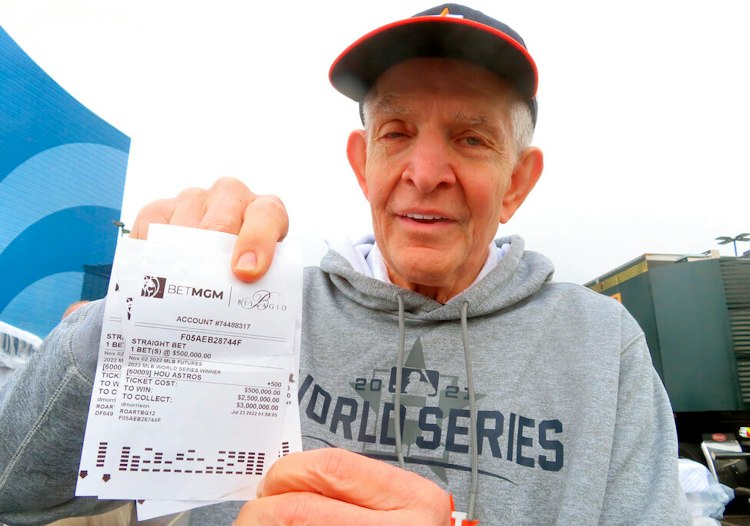
McIngvale turned his own money into the hedge directly. Rather than count on a payout coming from somewhere else, he bet on the outcome himself, sizing the wager to cancel out exactly the liability his own promotions created.
Gallery Furniture's promotions have long carried some version of "your purchase is free if the Astros win," and McIngvale has backed them personally with sportsbook bets for years. He staked roughly $13 million on the Astros in 2019 and lost it when Houston fell to the Washington Nationals in Game 7.
In 2021, he spread $3.25 million across several sportsbooks, including a $2 million bet at +1000 odds with William Hill (now Caesars) that alone would have paid $22 million, and lost again when the Astros fell to the Atlanta Braves.
In 2022, he staked $10 million and collected close to $75 million when Houston beat the Philadelphia Phillies, nearly matching the roughly $74 million Gallery Furniture refunded to customers.
He ran the same play on the Bengals for Super Bowl LVI, staking about $9.5 million across two bets, and lost that too when Cincinnati fell to the Los Angeles Rams.
Dimers' NFL futures hub tracks that same category of bet, a team's title odds, months out, for anyone running the numbers on next year's Super Bowl field.
That version of the hedge worked, and worked about as cleanly as insurance is supposed to, but it required two things almost nobody else had: enough capital to absorb the losing years, and sportsbooks willing to take multimillion-dollar action from one customer.
That combination kept the strategy as a one-man novelty rather than a repeatable business practice.
This is the chapter Fortune actually wrote about, and the first one where the capital barrier mostly disappears. Columbia law professor Joshua Mitts told Fortune the structure is "functionally quite similar" to bespoke insurance, best suited to clean yes-or-no outcomes like games and weather. He also warned that a business hedging on information it has a particular edge on could end up a "systematic loser" if sharper counterparties are on the other side, and that prediction markets generally lack an insurer's fraud controls, calling the space "a bit of a free-for-all."
Dartmouth economist Eric Zitzewitz took the more optimistic view, telling Fortune that high-volume sports markets have "so much data, so much repetition" that they can be "very well-calibrated," while acknowledging users pay fees for that pricing. Fortune also pointed to trades on future Amazon credit card receipts as a real-time read on consumer spending, with Zitzewitz calling that kind of signal "probably a better signal for you than GDP growth" and "certainly fresher."
Smaller operators are already running versions of this without a substantial bankroll. A Manhattan bar called the Jeffrey bought $5,000 worth of Kalshi contracts on the Knicks to cover a tab-matching promotion during the NBA Finals, a trade casino.org described as "taking a page out of the playbook" of Mattress Mack himself.
Fortune also reported that an insurer placed trades that could pay out up to $3 million against a coaching bonus tied to LSU's national championship odds, and that a Los Angeles ice cream shop covered close to half its monthly rent by betting on when cold fronts would arrive.
The volume backing this is real. Pew Research Center reported that combined trading on Kalshi and Polymarket roughly doubled between May and July 2026, driven mostly by sports, with Kalshi’s sports trading alone topping $58 billion and Polymarket's nearing $22 billion across June and July.
McIngvale tried to complete the loop himself this season, moving his Astros hedge to Kalshi for the first time. In late September, with Gallery Furniture's current promotion carrying an estimated $4 million in liability that could grow toward $12 million on a deep run, he staked $516,000 for a potential $13 million payout. McIngvale said Kalshi's market makers gave him 24-1, better than the roughly 18-1 sportsbooks were offering once Houston had clinched its playoff spot.
Our MLB odds hub tracks exactly that kind of line movement across books in real time. Kalshi's business development director, Nicolas Hull, told the New York Post the pricing reflects "the advantage of an exchange, where price discovery happens through competition." McIngvale also used Kalshi because traditional online sports betting remains illegal in Texas, where Gallery Furniture is based, while Kalshi's federally regulated exchange operates in the state.
The hedge didn't pay off. The White Sox swept the Astros 2-0 in the AL Wild Card Series on September 30, ending Houston's season before McIngvale's position could pay out. Unless he closed the trade before elimination, which Kalshi's structure allows but which hasn't been reported either way, it settled as a loss, the same result as three of his previous four tracked seasons.
Running the stakes and results that are confirmed across those seasons, the $13 million lost in 2019, the $3.25 million lost in 2021, the $9.5 million lost on the Bengals, and the $516,000 lost on Kalshi this year add up to about $26.3 million across four losing bets. Against that, the $10 million staked in 2022 turned into a reported $75 million payout, a profit of roughly $65 million on its own. Net it out and McIngvale is still close to $39 million ahead across the five tracked seasons, almost all of it earned in the one year the hedge actually paid.
That is what a hedge paying a premium most years and collecting a claim in one of them is supposed to look like, whether it runs through a sportsbook or an exchange. For anyone who wants to see how the math stacks up on this week's slate rather than a decade of World Series bets, Dimers Pro carries unlimited predictions and best bets across every sport we cover, built from the same kind of odds and probability work in this story. You can pause or cancel anytime.
Hedging sports risk, whether through a sportsbook, an arbitrage spread, or a Kalshi contract, still carries real downside, as McIngvale's own record shows.
If betting is affecting you or someone close to you, Dimers supports responsible gambling and encourages setting limits before placing a wager.


Nick Slade, with nearly two decades of experience, is the Chief Content Officer at Cipher Sports Technology Group, overseeing content for Dimers. He specializes in soccer, NBA, and NHL betting, leveraging predictive analytics and machine learning to provide accurate betting insights.