Oct 29, 2026
Blockchain betting explained: From Bitcoin to bots
Read Article 
Saquon Barkley says NFL rules forced him to sell his Polymarket stake.
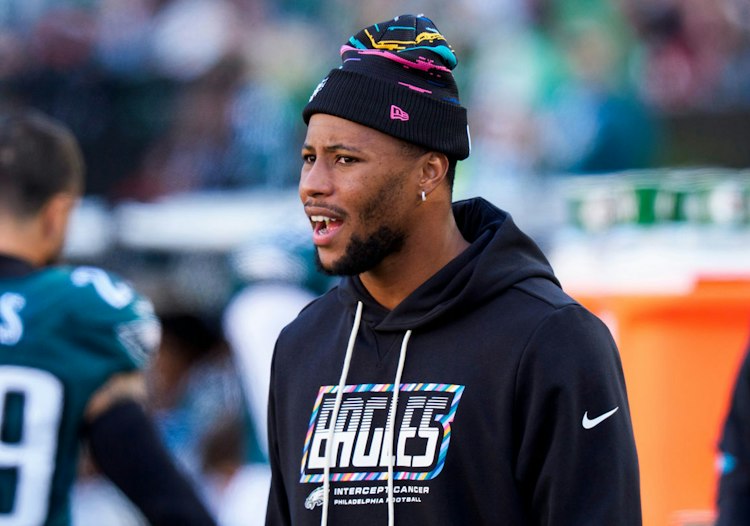
Philadelphia Eagles running back Saquon Barkley has revealed that the NFL forced him to give up his investment in Polymarket, underscoring the league's resistance to prediction markets even as other major sports organizations embrace them.
In an exclusive interview with Front Office Sports, Barkley confirmed that he previously held an equity stake in Polymarket but was required to divest because of league rules prohibiting players from investing in or endorsing gambling and prediction market companies.
"I am not in that right now," Barkley told Front Office Sports. "I am not allowed to be in that."
The revelation comes at a particularly interesting moment for the prediction market industry, with the NBA announcing Kalshi and Polymarket as its preferred prediction market partners earlier this week.
While other major leagues are increasingly treating prediction markets as commercial opportunities, the NFL is maintaining a very different position.
Barkley's investment in Polymarket was publicly disclosed in a September 2025 profile of his startup portfolio.
According to Front Office Sports, the NFL subsequently clarified that its existing restrictions on players having financial interests in gambling companies also apply to prediction market operators.
Barkley explained that the league communicates its rules around endorsements, investments, and other activities to players before each season.
"So I kinda had to get out of that," he said.
The NFL confirmed to Front Office Sports that players are prohibited from investing in or promoting sportsbooks and prediction markets, although it declined to comment specifically on Barkley's situation.
Polymarket also declined to comment.
The timing and financial details of Barkley's divestment have not been disclosed.
The NFL has consistently argued that sports prediction markets should be treated as gambling products, despite their different regulatory classification.
Platforms such as Kalshi and Polymarket offer event contracts through a federally regulated framework, while traditional sportsbooks generally operate under state gambling licenses.
That distinction has become central to an ongoing dispute between prediction market operators and state gaming regulators.
The NFL has sided with the states.
Earlier this month, the league urged the US Supreme Court to consider a case involving the regulation of sports event contracts, arguing that states should retain authority over these products rather than leaving oversight exclusively to the Commodity Futures Trading Commission.
The league has also raised concerns about age restrictions, insider information, and markets that could be vulnerable to manipulation.
Its position extends beyond regulation.
The NFL has refused to enter commercial partnerships with prediction market operators and has prohibited prediction market advertising during the Super Bowl.
Yet the league maintains official sportsbook relationships with DraftKings, FanDuel, and Fanatics.
That creates an important distinction: the NFL is not opposed to commercial relationships with betting companies, but it is taking a clear stance against prediction markets and player involvement in gambling-related businesses.
The NFL's position is increasingly different from that of other major US sports leagues.
The NBA announced Kalshi and Polymarket as preferred prediction market partners this week, although those agreements do not extend to the WNBA.
Major League Baseball signed an exclusive agreement with Polymarket in March, while Major League Soccer also has a partnership with the platform.
The NHL was the first of the major leagues to announce agreements with both Kalshi and Polymarket.
Individual athletes have also become increasingly involved.
Milwaukee Bucks star Giannis Antetokounmpo has invested in Kalshi, while LeBron James has a promotional agreement with Polymarket.
According to previous reporting by Front Office Sports, James's deal is worth approximately $15 million annually and will focus on football rather than NBA-related contracts.
The NBA allows certain player investments and endorsements involving prediction markets but restricts players from promoting NBA-related event contracts.
That approach contrasts sharply with the NFL's broader prohibition.
For Barkley, an investment that another league's rules might permit conflicted with his responsibilities as an active NFL player.
The differences between the leagues highlight a wider issue facing prediction markets: there is still no consistent approach to how sports organizations should engage with the industry.
Some leagues are embracing commercial partnerships while imposing restrictions designed to protect competition integrity.
Others, particularly the NFL, remain concerned about whether existing regulation provides sufficient safeguards.
For customers, the distinction matters because league involvement can influence access to official data, the types of contracts available, and the protections surrounding sports-related trading.
A partnership with a major sports league does not automatically mean every contract offered by a prediction market is free from integrity concerns.
Equally, the absence of an NFL partnership does not establish that a particular platform or contract is inherently unsafe.
The more meaningful questions concern how markets are monitored, what restrictions apply to participants with inside information, and how suspicious trading activity is investigated.
Those considerations remain important regardless of whether a product is classified as sports betting or event-contract trading.
Barkley's forced divestment offers a particularly clear example of how seriously the NFL is treating its position on prediction markets.
While athletes in other leagues are signing endorsement agreements and acquiring equity stakes, the NFL is telling its players to stay out.
The league's approach could evolve as the regulatory landscape develops, but there is no indication from its current policy that it intends to follow the NBA, MLB, or NHL in prediction market partnerships.
For now, the message to NFL players is straightforward: even if prediction markets operate under a different legal framework from traditional sportsbooks, the league considers them subject to the same restrictions on player investments and endorsements.
And as Barkley discovered, that can mean giving up a financial stake in one of the industry's biggest companies.


Damien Souness is Chief Experience Officer at Cipher Sports Technology Group, helping lead sports media brands such as Dimers. He specializes in creating trustworthy and data-driven content for sports fans, with experience working for globally recognized sports and media organizations.